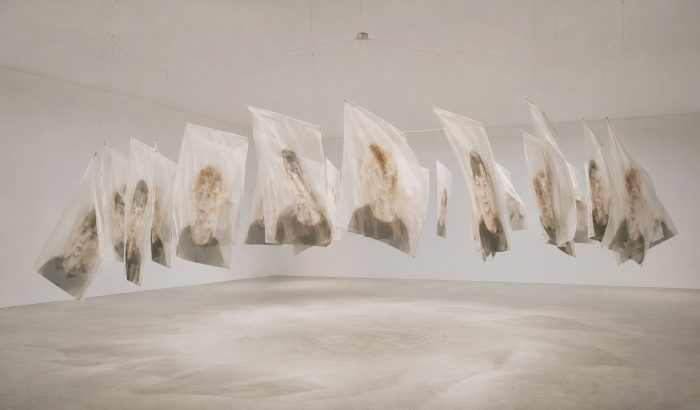
Gironeve è un’installazione fotografica composta da ventidue veli sospesi, undici uomini e undici donne, riuniti in una struttura cinetica che imprime all’opera una lenta rotazione. Ogni fotografia riunisce tre diversi gesti della stessa persona in un unico scatto, ottenuti attraverso una lunga esposizione durante la quale il corpo viene progressivamente rivelato da successivi lampi di flash. La sovrapposizione degli istanti dissolve la fisicità dell’immagine e restituisce una presenza fragile ed effimera, sospesa tra apparizione e scomparsa.
Il titolo riprende l’acronimo GIRONEVE, utilizzato in ambito medico per ricordare -attraverso le iniziali dei colori- il corretto posizionamento degli elettrodi dell’elettrocardiogramma. Il battito cardiaco diventa così il principio che scandisce l’intero lavoro: un ritmo costante che attraversa la fotografia e trova continuità nella lenta rotazione della struttura. Come un respiro, il movimento dell’installazione accompagna l’affiorare e il dissolversi delle figure, evocando la fragilità della presenza umana e il carattere imprevedibile delle relazioni, che nel tempo si trasformano, si rafforzano o si dissolvono. Il ritratto non restituisce un’identità immobile, ma una traccia, una presenza che prende forma nella relazione tra corpo, luce e tempo.
Gironeve is a photographic installation composed of twenty-two suspended veils portraying eleven men and eleven women, brought together within a kinetic structure that imprints a slow rotation on the work. Each photograph brings together three distinct gestures of the same person within a single image, created through a long exposure during which the body is gradually revealed by successive flashes of light. The superimposition of these moments dissolves the physicality of the image, giving rise to a fragile and ephemeral presence suspended between appearance and disappearance.
The title derives from the acronym GIRONEVE, a mnemonic used in the medical field to remember—through the initials of the electrode colors—the correct placement of electrocardiogram (ECG) electrodes. The heartbeat thus becomes the underlying principle of the entire work: a constant rhythm that runs through the photographs and continues through the structure’s slow rotation. Like a breath, the movement of the installation accompanies the emergence and fading of the figures, evoking the fragility of human presence and the unpredictable nature of relationships, which over time may transform, deepen, or dissolve. The portrait no longer represents a fixed identity, but rather a trace—a presence that takes shape through the relationship between body, light, and time.